Weight you actually feel
The gap between a 24 pound bike and a 34 pound one shows up on every start from a stoplight and every bridge approach. It matters more on short urban rides than on long flat ones.
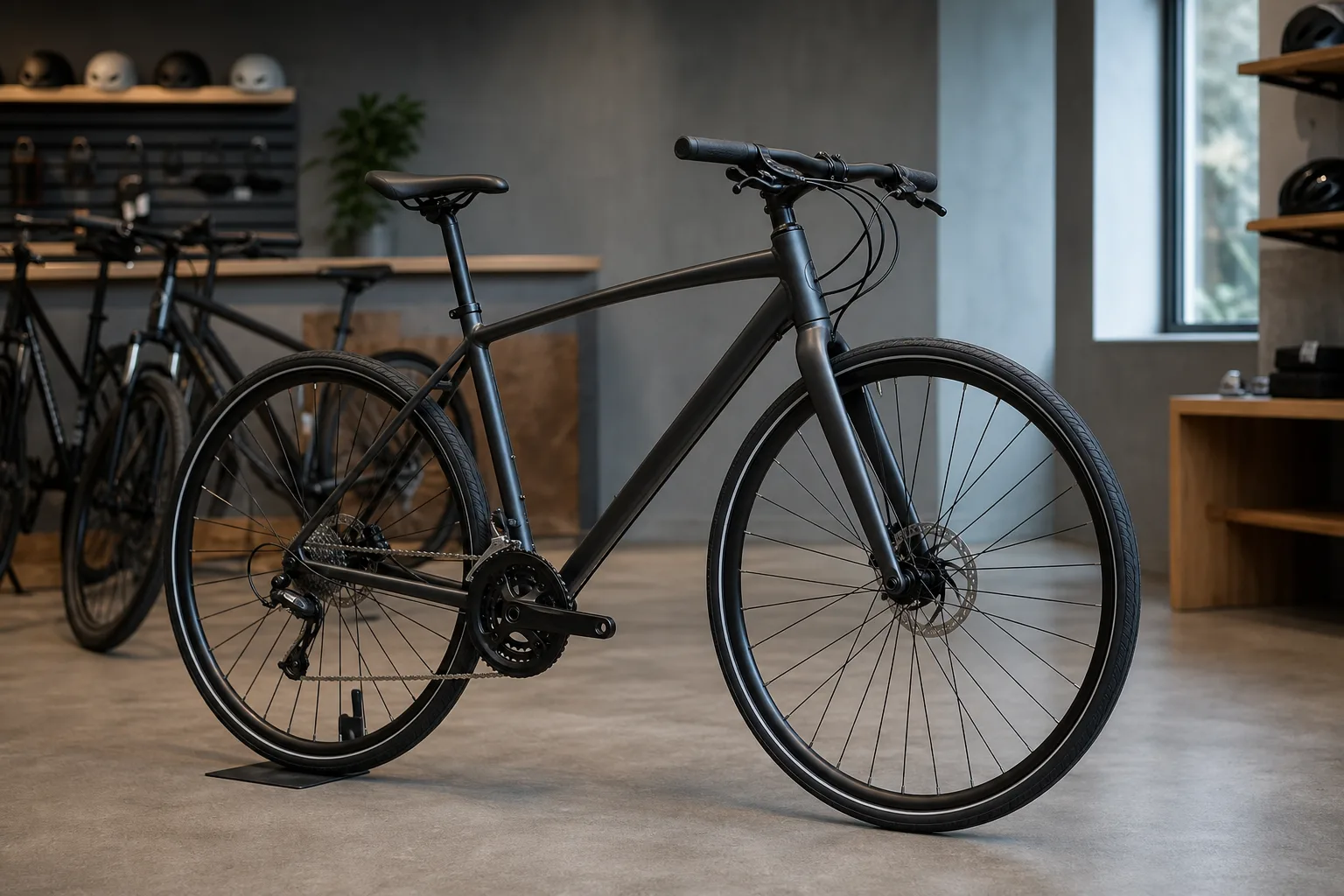
A frame that clears only 32 millimeter tires cannot be persuaded to take 40 later. Measure the gap at the chainstays and fork before you commit.
Threaded eyelets on the fork and rear dropouts decide whether the bike can carry anything or keep road spray off you. Their absence is not fixable with parts.
Fenders, a rear rack, lights and a serious lock commonly add a couple of hundred dollars before the bike is genuinely useful for errands. Budget for the whole setup, not the frame.
The department-store bike that prompted this was heavy in a way that only became obvious on the fourth block, and it was wrong in three separate directions at once: too upright to hold thirteen miles an hour into a headwind, too soft in the suspension fork to climb anything, too narrow in the gear range to do either comfortably. Replacing it meant walking into a shop and discovering that the category between a road bike and a mountain bike has no fixed borders, no agreed vocabulary, and at least three names for what is frequently the same machine. That confusion is not accidental, and it is navigable once you know what varies and what does not.
A hybrid, in practice, is a bike with 700c wheels, tires somewhere between 32 and 45 millimeters wide, flat handlebars, rim or disc brakes, and a gear range wider than a road bike's but narrower than a mountain bike's. That is the whole definition, and it is loose enough to contain machines that ride nothing alike. Within it sit bikes weighing 24 pounds and bikes weighing 34, bikes with rigid aluminum forks and bikes with 63 millimeters of cheap suspension travel, bikes with three chainrings and bikes with one. The label tells you the shape of the thing. It tells you almost nothing about how it will feel at mile six.
Manufacturers segment the same underlying frame by changing four parts and the paint. Fit a shorter stem, a taller head tube spacer stack, a swept-back bar and a padded saddle, and the marketing calls it comfort. Fit a longer stem, a flat bar, narrower tires and a firmer saddle, and the same frame becomes fitness. Leave it in the middle and it is a hybrid. Shops selling Hybrid Bikes alongside comfort and fitness lines are frequently offering three arrangements of one design, which is useful news, because it means the difference you are choosing between is mostly adjustable and mostly cheap to change later.
The parts that are not adjustable are the ones worth spending attention on. Frame material and geometry are fixed at purchase. Maximum tire clearance is fixed. Whether the frame accepts a rack and fenders, and whether the fork has eyelets for them, is fixed. Brake type is effectively fixed, since converting rim to disc is not economical. Everything else, the bar height, the stem length, the saddle, the tire width within the clearance you have, is a change costing between twenty and a hundred and fifty dollars that a shop can make while you wait.
The productive question is not which category suits you. It is what your actual week contains. Write down the five rides you made most recently, or the five you expect to make, with distance, surface, load and weather. Four miles each way to a train station on patched asphalt, carrying a laptop, in all seasons, is a specification. So is eleven miles of crushed limestone path on Saturday mornings with nothing on your back. The first wants fenders, a rack, wider tires and lights. The second wants lower weight and a gear range that lets you hold a pace. One bike can do both, but it will be set up for one of them and merely tolerate the other.
Load is the variable most often skipped, and it changes the answer more than any other. A bike that carries twenty pounds of groceries on a rear rack needs a stiffer frame, a longer wheelbase, tires run at pressures that will not pinch flat, and brakes that stop a loaded bike on a wet descent. The Consumer Product Safety Commission is responsible for the federal safety requirements bicycles sold in the United States must meet, which covers braking and assembly among other things, but a floor is a floor, and a bike adequate for an unloaded rider on a dry street is not automatically adequate under a full pannier.
The money is not only the sticker. A commuting setup adds fenders, a rack, a lock worth stealing nothing past, and lights, and those items together typically run a couple of hundred dollars beyond the bike. A shop-assembled bike includes a first tune-up and a person who will swap a stem for you. A big-box bike costs less and then costs a professional assembly check, because the bikes are boxed and built by people with no particular training in it. The real comparison is the bike plus everything it needs before it is useful, over the three or four years you will ride it.
The cost of choosing wrong is smaller than the anxiety around it suggests, provided the fixed parts are right. A saddle that hurts is a sixty dollar problem. Bars too low are a stem swap. Tires too narrow for the path you ride are a replacement you were going to make anyway at the end of their life. A frame that will not take fenders, or clears only 32 millimeter tires when your route wants 40, is the one mistake that stays a mistake, and it is the one worth ten minutes with a tape measure and a shop mechanic before you pay.
Bring the list of five rides to the shop and let someone read it back to you as a set of parts. The conversation that follows is short, specific, and considerably more useful than any category name printed on a down tube.